
brand
FIRST BANK: STILL STANDING GIDIGBA 125 YEARS AFTER

BY ALEX OTTI
This week marks the celebration of the 125th anniversary of the existence of the First Bank franchise in Nigeria. This stands the bank out as one of the earliest institutions established in West Africa, and obviously, one of the handful still in existence today. The bank began as the Bank of British West Africa (BBWA) in 1894 and quickly began playing the role of the Central Bank of British West Africa in the absence of a regulator at those medieval times in the sub region. The bank witnessed the amalgamation of the Northern and Southern protectorates and the eventual independence of Nigeria in 1960. It was founded by Alfred Lewis Jones, a shipping magnate who imported silver currency into West Africa through Elder Dempster shipping company also owned by him. In 1957, the bank changed its name to Bank of West Africa (BWA). Sequel to Nigeria’s independence in 1960, the bank began to extend more credit to indigenous Nigerians as most of its credit facilities were hitherto concentrated on foreigners living in the erstwhile colony. Standard Bank acquired the Bank of West Africa in 1966 and changed its name to Standard Bank of West Africa. In 1969, Standard Bank of West Africa incorporated its Nigerian operations and its name had to change once again, this time to Standard Bank of Nigeria Ltd (SBN). In 1971, SBN listed its shares on the Nigerian Stock Exchange and placed 13% of its share capital with Nigerian investors. Following the implementation of the indigenisation policy of the then military government soon after the civil war, Standard Chartered Bank reduced its stake in SBN to 38%. This action led to another change in name to First Bank of Nigeria in 1979 as Standard Chartered Bank insisted that since it had lost majority control, the bank should no longer bear its name since by the action, it had failed to be its full fledged subsidiary. This marked a watershed in the history of the bank as more Nigerians were appointed to the board and it began to look and operate more like a Nigerian bank. The bank had subsequently moved from a limited liability company to a publicly quoted company and back to a limited liability company which it presently is. The latest status is in compliance with changes in the regulatory environment in 2012 that required that the group operates as a holding company, with the bank as one of its subsidiaries or spin off other operations not related to banking. That marked the birth of FBN Holdings which presently has the bank and non bank subsidiaries as part of the group.
 In 1982, First Bank opened a branch in London and converted same to a full fledged subsidiary, FBN Bank (UK) in 2002. Two years later, in 2004, a representative office in Johannesburg, South Africa, debuted. At the moment, First Bank has subsidiaries or representative offices in France, China, Democratic Republic of Congo, Gambia, Sierra Leone, Ghana, Guinea and Senegal. At the last count, First Bank had presence across 10 countries in three continents. It operates from over 750 locations and employs close to 22,000 people. Its has over N3.3trillion in total assets. It also boasts over N2.5trillion in Customer deposits with a tidy 19% Capital Adequacy Ratio (CAR). The bank has over 1.3m shareholders and over 14million customers. Before going further, I must, in the full disclosure tradition of this column, declare that I joined First Bank as an Assistant General Manager on April 1, 2001 and left 10 years after, having risen to the position of Executive Director in 2011. I joined as part of the transformation team of the bank set up following a decision to institute comprehensive reforms in the bank. The project, titled, “Century 2, the New Frontier” effected a total change in the way things were done in the bank. Readers will realize, in the course of this essay, that a major part of the resilience and longevity of the bank has to do with its ability to keep pace with changes, not just in the banking ecosystem, but the global environment.
It is pertinent to note that so many institutions and companies disappear after only a few years of existence and therefore, there must be some distinguishing characteristics that have made First Bank, not only to survive but to excel in the last one decade and a quarter. I will attempt to share my own thoughts on this, which would definitely not be exhaustive.
One thing that stands the bank out is that everything it does is woven around strategy. In my days at the institution, and I believe it should still be the same now, the bank will start a year with long board and management strategy sessions. These comprise long and short term strategies. The long term strategies normally have a horizon of 5 years while the short term ones are normally between one and three years. I am sure some people, particularly in other environments, will argue that 5-year strategies would be at best described as medium term, but the truth is that in the Nigerian market, 5 years is even too long given how rapidly things change here! Organizations succeed and fail on strategy. The profound saying that when you fail to plan, you plan to fail fits in perfectly here. It is also said that when you are not certain about where you are going, any road takes you there. Having a clear strategy is one thing, achieving flawless execution is another.  I am aware of organisations that are very long on plans and short on implementation. On this, you must give it to First Bank as it is also very good on monitoring and measurement. It is a known fact that what doesn’t get measured, hardly gets done. So, to execute, you must have measurement tools and put in place, a system that not only rewards good performance but also poor performance. I can still remember our strategy sessions as we joined in 2011, where the then CEO, Mr. Bernard Longe reeled out the Big Hairy Audacious Goal (BHAG) of “being twice as large as the second largest bank in Nigeria by a defined future date”. Yes, the bank may not have achieved that goal within the timeframe, but it did have a goal and it did work towards that goal. It is in strategy that you define who you want to be, who you want to serve, how you want to serve them and what distinguishes you from the “guy down the road”. Once you have those agreed, the tools and the people must also be addressed. I have seen situations where management disbands a strategy put in place by the organisation only to replace it with a weak strategy or none at all and in consequence end up as lunch for competition. First Bank is noted for its very strong corporate governance regime. I believe this is at the heart of the longevity of the bank. In our days and I believe it is the same till today, there are things you simply could not do irrespective of who you were. Just like any organsation, the bank had a soul, meaning the key board members who called the shots. But every decision had to go through a process. Having survived over a long period of time, most things were documented and rules were strictly adhered to. I recall that even loan applications from viable businesses of shareholders of the bank must not only be disclosed, but must go through rigorous processes before they were approved. And with the Risk Management function under very experienced professionals with the brilliant Sanusi Lamido Sanusi, who was later to become CEO of the bank and six months later, the CBN Governor and currently the Emir of Kano, you couldn’t go round the process. By the way, it will not be out of place to mention that I was appointed an Executive Director the same day, September 4, 2005 with HRH Sanusi who had joined from UBA. Others appointed same day with us were Oladele Oyelola, Remi Babalola who went on to become Minister of State For Finance, and Mrs Bola Adesola, the current CEO of Standard Chartered Bank. We joined the only surviving executive director from the regime before ours, Mr. John Aboh, who is the current Chairman of Ecobank Nigeria and the then CEO of the bank, Mr. Jacobs Moyo Ajekigbe. As we were appointed, we were handed over a merger and acquisition deal, (some called it outright takeover bid) with another bank with footprints in some other African countries. The deal looked good on the surface, but some of us saw danger in the whole transaction as proposed. We struggled with that transaction for close to two years before resting it. Even though there was very strong support for the deal from some influential shareholders, management thought it was not going to create value for First Bank and therefore had to let it die a natural death. Yours truly had argued then that based on “back of the envelope analysis”, over 60% of mergers and acquisition destroy shareholder value. This my held position was to be corroborated by the Harvard Business Review Report in 2015 which stated that between 70% and 90% of mergers and acquisition destroy shareholder value and in fact fail. The reasons for failure are fully documented in the literature. One is glad that we still have the foremost Nigerian bank with us today celebrating its 125 years anniversary as some of us are persuaded that the situation would not have been the same if that deal went through. On this note, permit me to acknowledge the resilience of Mr. Jacobs Moyo Ajekigbe who showed strength of character as the buck naturally stopped on his table. One of the lessons to learn from the First Bank story is its ability to adapt to changing situations in the environment. For an organisation to adapt, it must understand the environment and be able to read changes and sometimes predict them, even before they happen. The reality is that human beings will normally gravitate around their comfort zones and oftentimes, become very resistant to change. It is only an organisation that constantly interrogates the status quo that will be able to adapt to changes or even lead the change itself. In our time, we realized that we had what our Human Capital Management department referred to an “aging workforce”. Like Clinton would say about Senator Dole, “we did not have a problem with their age, but with the age of their ideas”. The bank started a workforce renewal strategy which saw to the entry of young people with fresh ideas who could relate to the youthful population who were basically in control of the “new money”. To attract them, one needed people that not only looked like them but also reasoned like them. An age band was approved by management for different levels in the staff cadre. This tilted the average age of staff down significantly. Younger people were selected to replace those retiring on account of age. Technology was massively deployed as part of strategy. Service delivery, which was measured by external consultants, spiked in the positive direction. The bank was able to compete with smaller and younger banks, giving them a run for their money. The brand equity is an important part of any organisation, more so a bank. First Bank benefited so much from its brand. Because some banks had come and gone and bank failures has not ceased even at this moment, the bank benefitted from its longevity. Some people joke about dead people’s money being warehoused in the bank. Besides, what the brand represents is also the conscious effort at tweaking the brand to be in tune with modernity, of course without doing away with the reassuring effect of the ‘elephant’. I remember with nostalgia, the first strategy session we attended in Gateway Hotel, Otta in 2001, a new colleague, had proposed that the bank should do away with the elephant as the animal is not known to be smart, fast and efficient. We were all shocked at the response he got. Virtually everyone, except those of them that were new, charged at him, in the manner of the elephant he wanted removed. That was the last time he made that kind of suggestion. It was considered a heresy to remove the elephant. The rest of the people that mustered courage to speak about the elephant talked about how to make it nimble, how to face it forward rather than backwards, how to get the elephant to raise one of its legs and generally how it would reflect efficiency in strength.
Finally, I have always maintained that an organisation cannot be better than its people. First Bank has built a culture of employing very sound and good people. The recruitment process is excellent and gives little or no room for manipulation. The reward system ensures that the best people stay and misfits are gradually eased out. The compensation system remains competitive from what I hear and positions at the top are tenured such that the CEO and Executive Directors must retire after a maximum of two tenures of 3 years each. This policy makes it difficult for people to sit tight at those levels and also keeps the top open for deserving younger people to aspire. It is my sincere hope and belief that these time-honoured traditions of First Bank endure.
Let me therefore join millions of Nigerians to congratulate First Bank on this 125th Anniversary celebration and wish the Board, Management, Staff, Shareholders and Customers well. Of course, I pray for the continued sense of camaraderie that exists among the ex-staff of First Bank
brand
BANKING ON HER TOMORROW: ZENITH BANK EMPOWERS 300 GIRLS WITH EDUCATION, KNOWLEDGE AND CONFIDENCE
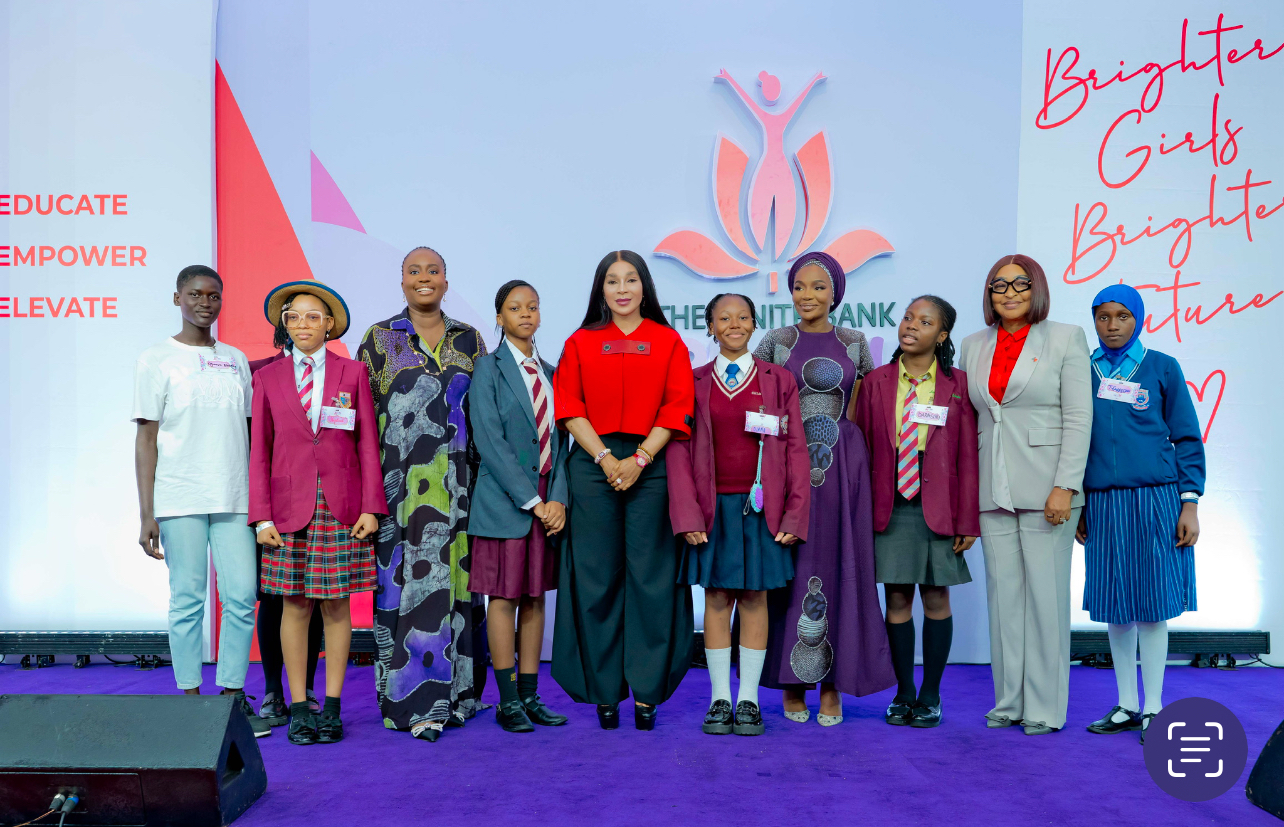
Zenith Bank Plc has launched the maiden edition of its Girl-Child Empowerment Programme, themed “Banking on Her Tomorrow,” bringing together 300 schoolgirls aged 13 to 17 from selected schools across Lagos for a day of learning, mentorship and personal development.
Held on Monday, October 12, 2026, at the Civic Centre, Victoria Island, Lagos, the programme featured sessions on finance and investment, etiquette and personal development, social media ethics, and social relationships and interactions, equipping participants with practical knowledge and skills for their personal, educational and future career journeys.
The initiative, a brainchild of the Bank’s Group Managing Director/Chief Executive Officer, Dame (Dr.) Adaora Umeoji, OON, reflects Zenith Bank’s commitment to nurturing the potential of young girls and helping them make informed choices about their futures.
In her welcome address, Dame (Dr.) Umeoji urged the participants to believe in their abilities, pursue their ambitions and remain focused and disciplined. Drawing on examples of young girls who have achieved remarkable feats, she challenged them to look beyond their present circumstances and envision the women they aspire to become.
“To all my amazing young ladies here today, each of you possesses gifts, talents, and ideas that are capable of revolutionising the world. You can revolutionise the world with your ideas,” she said.
The GMD/CEO further encouraged the girls to explore their interests and resist societal limitations, stressing the importance of taking ownership of their futures.
“Never allow gender or age to limit your goals. Whatever interests you today, explore it. Whatever you choose to pursue in life, give it your best shot,” she said.
Delivering the keynote address, Her Majesty, Olori Atuwatse III, Queen Consort of the Warri Kingdom, encouraged the girls to embrace their identities, develop resilience and use their abilities to make a positive difference in the lives of others.
Using the mangrove tree as a metaphor for resilience, she reminded the participants that challenges need not define their futures and that their worth extends beyond academic results and external expectations.
“Every time you affirm the truth about who you are, you are building confidence. Every time the tide of life goes out and you are still standing, you are building resilience. And every time you use your gifts for another person, you are discovering your purpose,” Olori Atuwatse III said.
The programme featured interactive sessions led by accomplished professionals and personalities:
Ayanime Edem, founder of The Elite Finishing School and modern etiquette educator, discussed confidence, communication, self-presentation and etiquette.
Nigerian actress and content creator Bukunmi Adeaga Ilori, popularly known as Kie Kie, addressed responsible social media use, authenticity and digital boundaries.
Representing Zenith Bank, Thelma Okonye and Adesola Adeyemo introduced the girls to saving, responsible money management and investment, highlighting the importance of developing sound financial habits early.
While Nigerian filmmaker, creative executive and educator,Praise Onyeagwalam, Director Pink, led a session on healthy relationships, self-awareness and effective communication.
The sessions encouraged active participation, giving the girls opportunities to ask questions and engage with the speakers on issues relevant to their experiences and aspirations.
The programme also featured competitions, with cash prizes totalling over ₦1 million awarded to winners. The participants received books to encourage reading and personal growth, while musical performances by Nigerian singers Qing Madi and No. 11 added to the lively atmosphere. The event was hosted by Temi Badru, public speaker, communications coach and lawyer, with Darasimi Destiny Nadi serving as mini host.
Delivering the closing remarks, Executive Director, Zenith Bank Plc, Dr. Mrs. Adobi Nwapa, highlighted the GMD/CEO’s vision for the initiative and the Bank’s commitment to sustaining its impact.
“The programme is the vision of our GMD/CEO, who conceived and championed it, demonstrating her unwavering commitment to the empowerment of the girl child. Through her leadership, she has shown the girls what is possible when a woman dares to lead. At Zenith Bank, our commitment to the girl child extends beyond today, and we will continue to nurture their aspirations through this annual initiative,” she said.
Dr. Nwapa thanked the speakers and participants for contributing to the programme’s success and encouraged the girls to apply the lessons learnt, remain confident and pursue their aspirations with determination.
The initiative builds on Zenith Bank’s longstanding commitment to advancing opportunities for women and girls through programmes including its annual International Women’s Day Seminar, the Zenith Women’s Basketball League, the Women of Honour Awards in partnership with the Ford Foundation, the Pad-a-Queen Initiative and Z-Woman, which supports women-owned businesses through business support and access to credit at discounted rates.
Through “Banking on Her Tomorrow,” Zenith Bank is extending this commitment to a younger generation, equipping girls with the knowledge, skills and confidence to pursue their ambitions and contribute meaningfully to their communities and society.
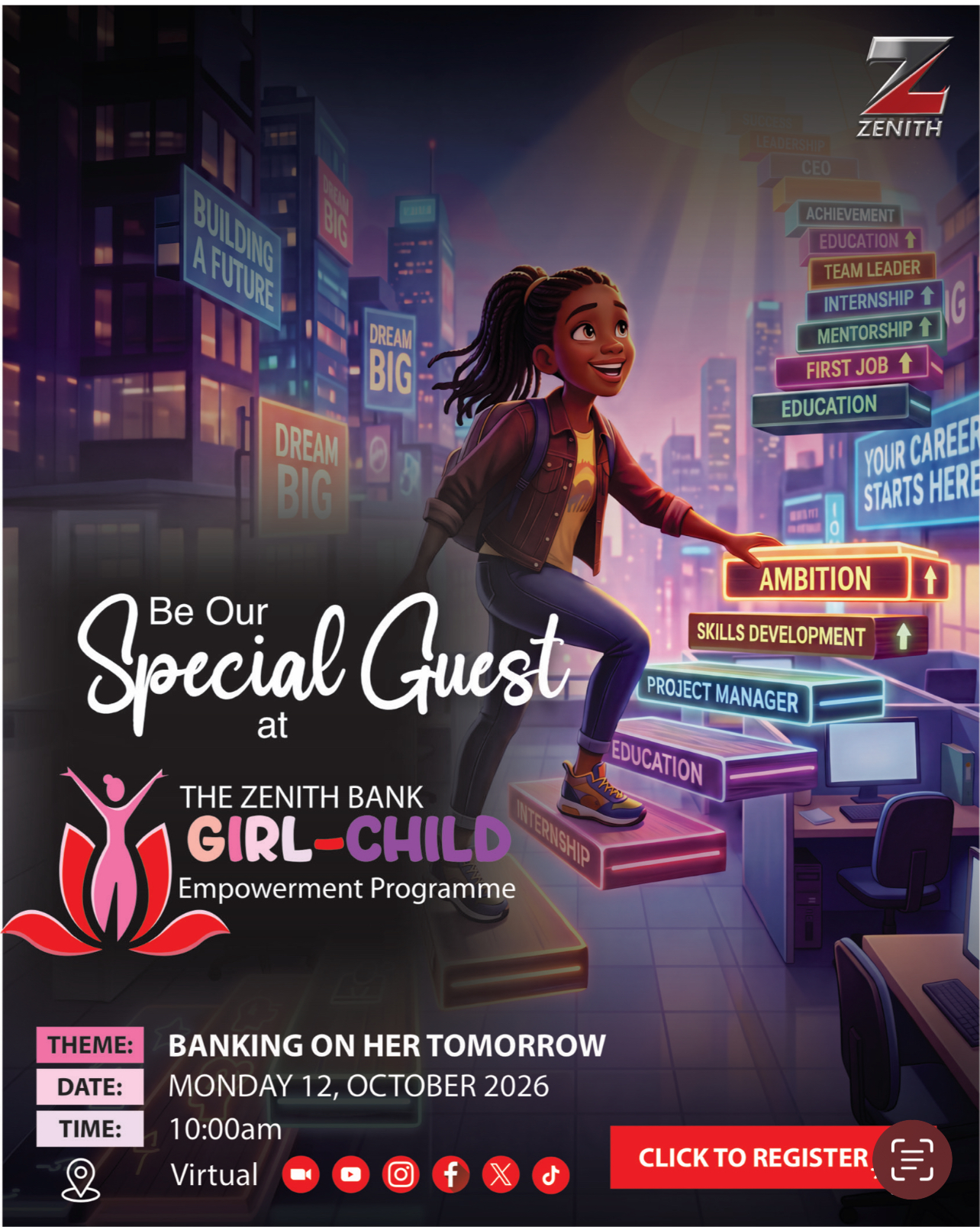
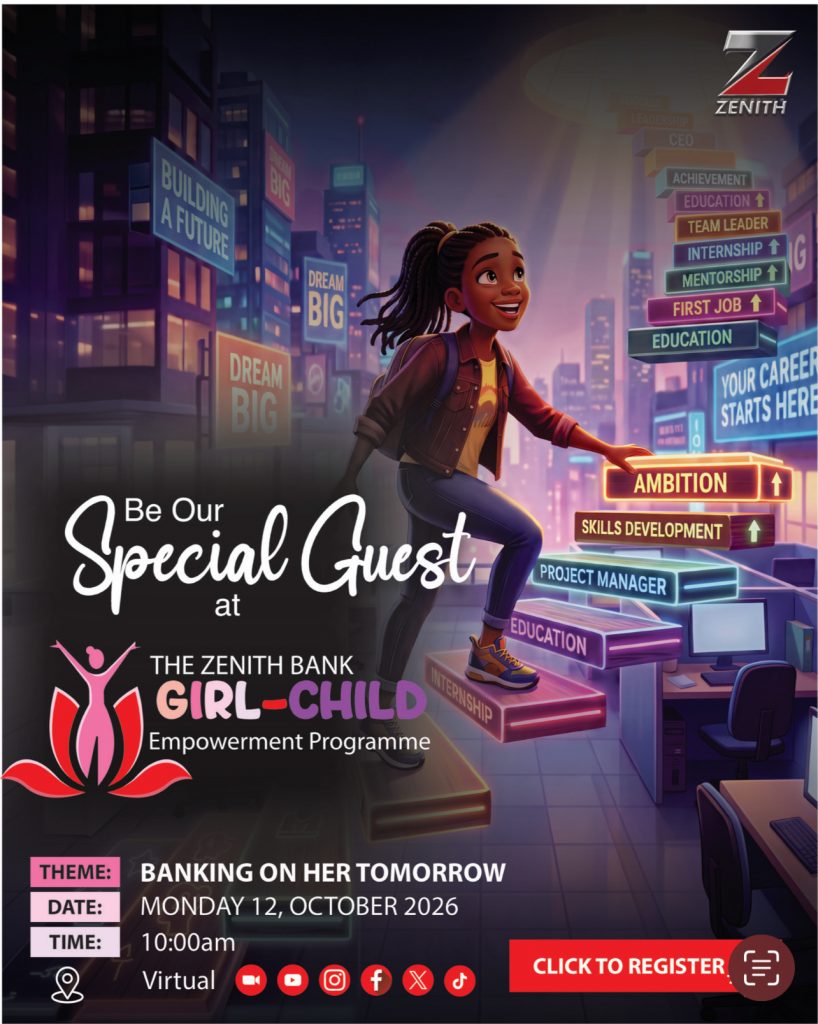
Zenith Bank Plc is set to launch the maiden edition of its Girl-Child Empowerment Programme, an initiative aimed at inspiring young girls to dream boldly, develop the skills and confidence to pursue their aspirations, and prepare for meaningful opportunities in the future.
The event, themed “Banking On Her Tomorrow,” is the brainchild of the Bank’s Group Managing Director/Chief Executive Officer, Dame Dr. Adaora Umeoji, OON, the first female GMD/CEO in Zenith Bank’s history and a strong advocate for girl-child education and empowerment. The event will be held virtually on Monday, October 12, 2026, at 11:00 a.m., a day after the International Day of the Girl Child, observed globally on October 11.
The programme, which will feature an impressive lineup of distinguished experts in various fields, seeks to provide girls with the inspiration, knowledge and practical perspectives needed to navigate their education and careers, while exposing them to opportunities in skills development, mentorship and leadership. As an annual platform, it will encourage girls to recognise their potential, broaden their aspirations and equip themselves to make informed choices about their future.
The initiative builds on Zenith Bank’s longstanding commitment to women and girls, demonstrated through programmes and platforms including the Bank’s annual International Women’s Day Seminar, its sole sponsorship of the Zenith Women’s Basketball League, the Women of Honour Awards in partnership with the Ford Foundation, and the Pad-a-Queen Initiative. These complement the Bank’s women-focused financial solutions, including the Z-Woman initiative, an empowerment programme that supports women-owned and women-led businesses through specialised funding, capacity building and networking. Together, these initiatives reflect the Bank’s broader commitment to supporting women and girls at different stages of their lives, and to contributing meaningfully to national development.
This maiden edition is open to all, with girls, parents, educators and other members of the public invited to participate. Interested participants can register via the link below. Those unable to join via Zoom can follow the live stream on Zenith Bank’s social media platforms.
brand
GTCO Plc Releases 2026 Half Year Audited Results …….. Reports Profit Before Tax of ₦603.03billion,Pays Interim Dividend of ₦1
 Guaranty Trust Holding Company Plc (“GTCO” or the “Group”) has released its Audited Consolidated and Separate Financial Statements for the period ended June 30, 2026, to the Nigerian Exchange Group (NGX) and London Stock Exchange (LSE).
The Group posted a profit before tax of ₦603.03 billion, driven by strong performance recorded on the interest and trading income lines, which grew y-o-y by 7.5% and 24.7%, respectively. The strong earningsrecorded was moderated by a ₦46.2 billion fair value loss recognized in H1–2026, limiting y-o-y growth in PBT to 0.4%.
The Group grew across its asset lines, reinforcing a balance sheet that is well structured, liquid and diversified. This growth was recorded in each jurisdiction where we operate a banking franchise, and across our Payments, Pension and Funds Management businesses.”
Group’s Total assets and shareholders’ funds closed at ₦18.6trillion and ₦3.3trillion, respectively. Capital Adequacy Ratio (CAR) remained very strong, closing at 34.9% (Bank 29.2%), and asset quality improved as evidenced by IFRS 9 Stage 3 Loans which closed at 3.5% and 4.6% % at both Bank and Group Level in H1-2026 (Bank -3.4%, Group 5.0% in FY-2025). Cost of Risk (COR) improved to 0.6% from 2.2% during the same period.
The Group’s Loan book (net) grew marginally by 0.5% from ₦3.13trillion as of December 2025 to ₦3.15trillion in June 2026, converse for improved performance on Deposit liabilities which grew by 10.3% from ₦12.87trillion to ₦14.19trillion during the same period.
Commenting on the results, the Group Chief Executive Officer of Guaranty Trust Holding Company Plc (GTCO Plc), Mr. Segun Agbaje, said; “Our half year results speak to the strength of what we have built: a resilient franchise, a strong balance sheet and a business that no longer depends on banking alone. Fair value movements weighed on reported earnings, but the core business held firm. Interest and trading income grew, deposits strengthened, and asset quality improved at Group level. The priority now is to execute with discipline and grow responsibly. Digital is our lever for scaling across Banking, Payments, Pension and Funds Management, and for building a more diversified and resilient financial services group.”
Overall, the Group continues to post one of the best metrics in the Nigerian Financial Services Industry in terms of key financial ratios i.e., Pre-Tax Return on Equity (ROAE) of 35.9%, Pre-Tax Return on Assets (ROAA) of 6.6%, Capital Adequacy Ratio (CAR) of 34.9% (Bank: 29.2%) and Cost to Income ratio of 31.5%.
GTCO Plc is a leading financial services group with operations across Africa and the United Kingdom. Renowned for its strong corporate governance, innovative financial solutions, and customer-centric approach, the Group provides a wide range of banking and non-banking services including payments, funds management, and pension fund administration. The Group is committed to delivering long-term value to stakeholders while driving growth and development across its markets


-
 news6 years ago
UPDATE: #ENDSARS: CCTV footage of Lekki shootings intact – Says Sanwo – Olu
-
 lifestyle6 years ago
Former Miss World: Mixed reactions trail Agbani Darego’s looks
-
 health6 years ago
Chairman Agege LG, Ganiyu Egunjobi Receives Covid-19 Vaccines
-
 lifestyle5 years ago
Obateru: Celebrating a Quintessential PR Man at 60
-
 news1 year ago
BREAKING: Tinubu swears in new NNPCL Board
-
 health6 years ago
UPDATE : Nigeria Records 790 new cases of COVID-19
-
news8 years ago
-
 entertainment2 years ago
Ashny Set for Valentine Special and new Album ‘ Femme Fatale’