
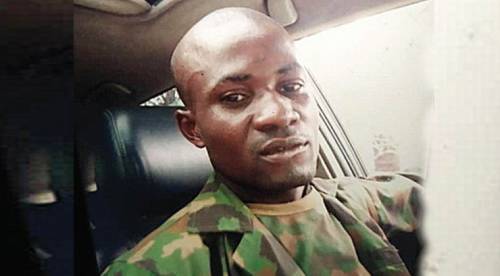
 One of the Commanders of the Eastern Security Network, the armed wing of the Indigenous People of Biafra, has alleged that members of his group engaged in a killing spree across the Southeast region.
The suspect, Emeoyiri Uzorma Benjamin, alias Onye Army, was arrested by operatives of the Force Intelligence Response Team over his alleged involvement in the attacks, killing of security operatives and the destruction of government and private property in Imo State.
Benjamin also confessed to being part of the attacks on security operatives on the alleged instruction of their supreme leader, Nnamdi Kanu.
He also claimed that the heads of 10 girls caught in Imo State were used in preparing charms to fortify members of the group against police bullets.
Read Benjamin’s confession below
“I am Emeoyiri Uzorma Benjamin, also known as Onye Army. I am from Uzombe Town in Uguta Local Government Area of Imo State, I am 28-year-old. I only attended secondary school. But I left school without writing my SSCE exams in 2014 because my father had no money.
“So, I started doing menial jobs and buying Nigeria Army forms and that of the Nigerian Navy, but I was not recruited because I was using my brother’s result. I intended to write my exam and get my result when I get drafted into the army.
“I also went to Lagos, where I secured a job as a security guard with a company that dealt in building materials. I did that job until 2017, when I relocated to my village, where I engaged in carpentry jobs.
“While I was in the village, one John, who is from my town, met me and told me he knew I was trying to join the military but advised me to join IPOB in 2019, so I started attending IPOB meetings in Orlu every Sunday. We used to have the meetings in a building close to the Teaching Hospital.
“I attended the meeting until November 2020 when Mazi Nnamdi Kanu formed the ESN and said he didn’t want any security agents in the South East and that all he wanted was just ESN operatives providing Security in the South East.
“I volunteered to join the ESN and I was trained in a camp close to the Niger Bridge, but I don’t know the name of the village. I spent two weeks in that camp with several other people who came for ESN training from several parts of the country.
“Some people had been in the camp before I joined them but I spent just two weeks in the centre. Before I went to the centre, however, I was at a Sabbath Church in Orlu owned by one Alewa Nwachuku in the Okporo area of Orlu.
“While at the camp, we were given military training and our phones were taken from us. We were not talking to Nnamdi Kanu directly, but we were receiving his instructions from our camp leaders. After our training, we were given boots and uniforms and were asked to go back to our state commanders.

“My state commander was late Ikonso, who was in charge of Imo State before his death. We were not given any money; we returned to our commanders with just the uniforms and the boots. When we got back to Imo State, I reported back to the Sabbath Church, which served as one of our camps at that time.
“Then Nnamdi Kanu ordered that he didn’t want to see any police or military checkpoint in the South East. The order was given through radio, and all the ESN State Commanders asked their fighters to comply with the orders.
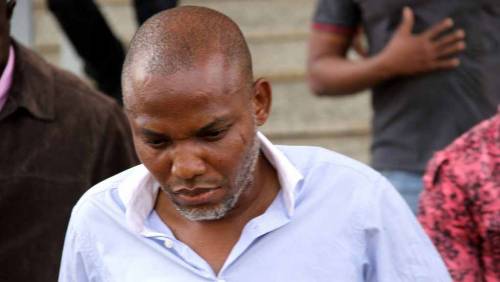 “Nnamdi Kanu said we should dismantle all checkpoints and even kill the security agents manning the checkpoints because they were killing Igbo people. I believed him and obeyed the order because I had taken an oath to obey Nnamdi Kanu, the supreme leader of IPOB.
“During our first attack, Ikonso brought two AK47 rifles while two of our members brought two locally made guns which we used to attack a police checkpoint in Orlu where we killed a police officer.
“Two of our members were also killed but the police officers ran away, abandoning their vehicle, which we burnt and took away one of the police rifles. After the operation, we all returned to the Sabbath church owned by Alewa but the police came and attacked the place.
“We then relocated to a farm belonging to one of our members in the Eele area of Awidemili, Anambra State. From there, we attacked several other police stations and checkpoints.
“Then Ikonso, Engineer Mike and Temple organized the attack at the Owerri Prisons and Imo State Police Command, where several inmates were freed and more than 50 police rifles were carted away on the instruction of Mazi Nnamdi Kanu because he said nobody deserved to be in prison.
“We came with over 100 fighters, but on our way back to our base, some soldiers attacked us and many of our fighters were killed at Ukorji area of Imo State. We carried out other attacks on security formations in Imo and Anambra states before Ikonso was killed. I was in his residence on the night he was attacked by security agents. I fought with my Ak47 rifle, but I abandoned it and escaped through the back gate when I expended all the bullets in the rifle.
“After the death of Ikonso, we went and burnt the governor’s house and killed a security man in the house in retaliation. It was Engr Mike that led us. I was part of those that shot at the gate.
“We also burnt a house in Amowmama, belonging to someone who was believed to have given the security agents information on Ikonso. Engr Mike then took us to his village in Awedemili, where we attacked a house belonging to someone he said was against our struggle and we killed two persons there.
“Mazi Nnamdi Kanu also directed us to bury Ikonso with 2,000 human heads but we have killed only 30 so far. I then relocated to Temple’s camp and Mazi Nnamdi Kanu ordered us to attack Orlu Police Division and free our fighters arrested and detained there.
“We went in 10 vehicles, over 50 fighters and we had over 30 rifles with us. I was in a white sienna and the late Dragon was in a red-coloured car, but before we got to the police station, we did a shooting display that was circulated on social media on the day we went to attack Orlu police station.
“The white and red clothes we tied on our bodies in the video were charms which we call local bulletproof and we prepared charms with the heads of 10 young girls.
“Before we proceeded to attack the Orlu Police Station, Temple and Mike brought the suggestion that we should get the girls we used for the charms and we got them here in Imo State. But before we got to the Orlu police station, an armoured police vehicle attacked us and killed 12 of our fighters and injured four.
“After we escaped from that attack, we went to our camp at Idiato to relax, waiting for further directives. They are not paying us any money; they said we are freedom fighters.
“Most of the police officers I killed were also Igbo people. I am happy that Nnamdi has been arrested. But I am begging for amnesty from the Federal Government.”

 Opeifa maintained that derailments are not peculiar to Nigeria, noting that such incidents occur across advanced rail systems globally.
 A quiet transformation is reshaping the daily commute between Nigeria’s commercial hub and the historic city of Ibadan. Passengers on the Lagos–Ibadan standard gauge corridor say services have become more efficient and predictable following a clampdown on ticket racketeering led by Kayode Opeifa