
brand
FIRSTBANK INTRODUCES THE FIRST HUMANOID ROBOT, REINFORCES ITS COMMITMENT TO PROVIDING INNOVATIVE FINANCIAL SOLUTIONS FOR CUSTOMERS


FirstBank has launched an industry first Humanoid Robot at its Adetokunbo Ademola VI, Lagos Digital Experience Centre (DXC) BranchThe robot is among the phased configuration of the bank’s state-of-the-art digitally led self-service branch The Humanoid Robot is equipped with Video Banking and Artificial Intelligence (AI), taking on the role of a friendly branch staff. In furtherance to its leading role in providing innovative financial solutions in Nigeria, First Bank of Nigeria Limited, Nigeria’s premier financial institution and leading financial inclusion services provider, has announced the launch of a Humanoid Robot, the first of its kind in the financial services space in Nigeria. The robot is equipped with Video Banking and Artificial Intelligence (AI), taking on the role of a friendly branch staff. The Humanoid Robot can engage customers in conversations as well as through a touch screen strapped to his chest. The services performed by the robot include responding to customer enquiries on cash deposits, withdrawals and ATM cards. The robot also aids complaint management as customers can log a complaint via QR with feedback generated within the advised time. The Humanoid Robot also keeps customers up to date with happenings about the Bank, including products launch and upgrades designed to strengthen the customer experience and satisfaction. The robot is a one-stop point to keep customers informed about the Bank. It also effectively manages customers’ accounts. Expressing his delight at the initiative, Dr Adesola Adeduntan, the CEO of FirstBank Group noted that “the addition of the Humanoid Robot to our state-of-the-art Digital Experience Centre represents a purposeful stride towards transforming the banking landscape in the country and further showcases the priority we give to innovation within the Bank. With its advanced capabilities, the robot is designed to elevate the quality of our customers’ lives in today’s rapidly evolving digital world. Our unwavering dedication to delivering unparalleled banking services remains steadfast, as we leave no stone unturned in innovating to fulfil our customers’ needs.” he concluded. The introduction of the Humanoid Robot is among the phased configuration of the Bank’s state-of-the-art digitally led self-service branch called Digital Experience Centre, launched in December 2021. Another Humanoid Robot will also be deployed in the Bank’s next and second Digital Experience Centre, soon to be announced in the coming months. About FirstBank First Bank of Nigeria Limited (FirstBank) is the premier Bank in West Africa and the leading financial inclusion services provider in Nigeria for 129 years. With over 800 business offices across our footprints and over 200,000 Banking Agents spread across 99% of the 774 Local Government Areas in Nigeria, FirstBank provides a comprehensive range of retail and corporate financial services to serve its over over 41 million customer accounts (including digital wallets) in Nigeria and over 700,000 customer accounts outside the country. The Bank has an international presence with subsidiaries operating in 9 other countries. These subsidiaries are FirstBank (UK) Limited in London and Paris, FirstBank in The Gambia,
FirstBank Sierra-Leone, FirstBank in the Republic of Congo, FBNBank in Ghana, FBNBank in Guinea, FBNBank in Senegal as well as a Representative Office in Beijing, China. The Bank is at the forefront of promoting digital banking in the country and has issued over 12 million cards, the first bank to achieve such a milestone. FirstBank’s cashless transaction drive extends to having more than 12 million people on its USSD Quick Banking service through the nationally renowned *894# Banking code and over 4.5 million people on the FirstMobile platform. It is, by far, the leader in the number of digital transactions per minute across multiple channels. FirstBank’s commitment to Diversity is shown in its policies, partnerships and initiatives, such as its employees’ ratio of female to male (about 39%:61%; and 32% women in management) as well as the FirstBank Women Network, an initiative that seeks to address the gender gap and increase the participation of women at all levels within the organization. In addition, the Bank’s membership of the UN Women is an affirmation of a deliberate policy that is consistent with UN Women’s Women Empowerment’s Principles – Equal Opportunity, Inclusion, and Nondiscrimination. Since its establishment in 1894, FirstBank has consistently built relationships with customers focusing on the fundamentals of good corporate governance, strong liquidity, optimised risk management and leadership. Over the years, the Bank has led the financing of private investment in infrastructure development in the Nigerian economy by playing key roles in the Federal Government’s privatisation and commercialisation schemes. With its global reach, FirstBank provides prospective investors wishing to explore the vast business opportunities available in Nigeria an internationally competitive world-class brand and a credible financial partner. For six consecutive years (2011 – 2016), FirstBank was named “Most Valuable Bank Brand in Nigeria” by the globally renowned The Banker Magazine of the Financial Times Group and “Best Retail Bank in Nigeria” eight times in a row, 2011 – 2018, by the Asian Banker International Excellence in Retail Financial Services Awards. Notably, in 2022, the Bank took a long stride on its growth trajectory with the Bank’s Viability and Long-Term Issuer Default Ratings upgraded to ‘B’ from ‘B-‘ (with Outlooks Stable) by Fitch, a leading global rating agency. This is an indication of the Bank’s strong internal capital generation and the corresponding recession of its risks to capitalisation. Fitch also upgraded the Bank’s National Long-Term Ratings to ‘A (nga)’ from ‘BBB (nga)’, to reflect its improved creditworthiness relative to that of other issuers in Nigeria. Furthermore, the Top 100 African Bank rankings 2022 released by The Banker Magazine revealed FirstBank’s ranking as number one in Nigeria in terms of Overall Performance, Profitability, Efficiency and Return on Risk. Other laudable feats in 2022 include FirstBank’s international recognitions on major indices by Euromoney Market Leaders, an independent global assessment of the leading financial service providers where FirstBank was crowned: Market Leader: (tier-1 recognition) in Corporate and Social Responsibility (CSR),Market Leader: (tier -1 recognition) Environmental, Social and Governance (ESG),Highly Regarded: in Corporate Banking and Digital Solutions, Notable: in SME Banking. Also, in 2022 International Finance Magazine named the Bank “Most Innovative Banking Product in Nigeria” and “Best Retail Bank in Nigeria”. FirstBank was also awarded “Best Corporate Banking Western Africa, 2022” and “Best CSR Bank Western Africa, 2022’’ by Global Banking and Finance Magazine. Other notable awards in FirstBank coffers include: “Best Bank in Nigeria” by Global Finance magazine – fifteen times in a row; “Best Private Bank in Nigeria-2021” awarded by Global Finance magazine; “Best Internet Banking Nigeria” and ‘’Best CSR Bank Africa’’ by International Business Magazine. In 2023, FirstBank has received notable awards including “Best Private Bank for Sustainable Investing in Africa 2023” by Global Finance Awards; “Best Sustainable Bank in Nigeria 2023” by International Investors Awards; “Best Bespoke Banking Services in Nigeria 2023” by International Investors Awards; “Best Financial Inclusion Service Provider in Nigeria 2023” by Digital Banker Africa; and “African Bank of the Year” by African Leadership Magazine. Our vision is ‘To be Africa’s Bank of first choice’ and our mission is ‘To remain true to our name by providing the best financial services possible. This commitment is anchored on our core values of EPIC – Entrepreneurship, Professionalism, Innovation and Customer-Centricity. Our strategic ambition is ‘To deliver accelerated growth in profitability through customer-led innovation and disciplined execution and our brand promise is always to deliver the ultimate “gold standard” of value and excellence to position You First in every respect.
I
Nigerians at home and in the diaspora seeking to participate in the landmark Initial Public Offering (IPO) of Dangote Petroleum Refinery and Petrochemicals can subscribe conveniently through Zenith Bank, a receiving bank for the historic transaction and a designated electronic application channel for the offer. Subscription is open through the Zenith Bank website, the Zenith mobile app, internet banking, USSD, corporate internet banking and any Zenith Bank branch nationwide.
Across all of these channels, anchored by Zenith Bank’s network of 456 branches and 84 cash centres, investors enjoy a secure, fast and reliable route into the offer from anywhere in the world, at any hour. Whether the application begins on a phone in London, a laptop in Houston or across the counter of a Zenith banking hall in Lokoja, the path to ownership opens with a few taps and carries the investor smoothly through to completion. Every subscription is linked to the investor’s Bank Verification Number, a seal of identity and security that accompanies each application from submission to allotment. It is service the Zenith way: first-time and seasoned investors alike enjoy a straightforward and fully protected process, and the quiet confidence that their stake in history is processed through Zenith Bank.
Applications open on Monday, 14 September 2026 and run for 30 days, closing on Tuesday, 13 October 2026. According to the prospectus, the shares are offered at ₦525 each, with a minimum subscription of 10 shares, or ₦5,250. The offer seeks to raise ₦2.15 trillion, the largest equity offering ever undertaken on the African continent, and the prospectus further provides that retail investors who subscribe and hold their shares may qualify for bonus shares under the Retail Investor Incentive Programme, subject to regulatory approvals.
Zenith Bank stands ready to make participation effortless for investors who choose to take part. Nigeria’s largest bank by Tier-1 capital and the country’s most profitable bank, Zenith has built its reputation on combining scale with innovation, and that strength is now at the service of every investor in this offer. This is proven ground for the bank: Zenith Bank’s own most recent public offering was executed mainly through digital channels, a demonstration of digital readiness built on the bank’s robust digital infrastructure. That infrastructure has since been strengthened further through a comprehensive technological overhaul, positioning Zenith to serve its retail customers with the same excellence long enjoyed by its corporate clients, precisely the capability an offer of this scale demands.
Within the wider transaction, Quantum Zenith Capital & Investments Limited serves among the joint issuing houses, while Zenith Bank itself provides the secure and dependable channels through which applications are received and processed. Having successfully taken its own landmark offer to the market through digital channels, Zenith brings that same tested infrastructure and experience to the largest equity offering in African history. It is the same combination of financial strength, digital excellence and customer devotion that has earned Zenith Bank recognition year after year as one of Africa’s foremost financial institutions, trusted by millions of customers and by the corporates and governments behind the continent’s biggest transactions.
For over three decades, Zenith Bank has been the trusted gateway to Nigeria’s defining financial moments, and its channels are open for this one. Investors who wish to participate can fund their Zenith Bank account and subscribe through any of the bank’s platforms before the offer closes on 13 October 2026.
Please note that the details of the offer are provided in the prospectus and guided by extant regulations. Zenith Bank serves as a Receiving Bank and electronic application channel for this offer. Investors are advised to carefully read the Prospectus and, where appropriate, seek independent professional advice before making any investment decision.
brand
ZENITH BANK’S 10TH INTERNATIONAL TRADE SEMINAR SETS OUT STRATEGIES TO SCALE NIGERIA’S NON-OIL EXPORTS
Zenith Bank Plc hosted the 10th edition of its International Trade Seminar on Non-Oil Export on Tuesday, 25 August 2026, marking a decade of sustained advocacy for the diversification of Nigeria’s economy. The virtual event brought together policymakers, regulators, exporters, manufacturers, investors and development partners from across Africa and beyond, all focused on one question: how Nigeria can earn more from what it sells to the world.
Held under the theme “Unlocking Value and Harnessing Growth”, the seminar examined how Nigeria can move beyond exporting raw commodities to building competitive value chains, strengthening trade infrastructure and financing, and deepening the sector’s contribution to sustainable economic growth.
In her welcome address, the Group Managing Director/Chief Executive Officer of Zenith Bank Plc, Dame (Dr.) Adaora Umeoji, OON, paid tribute to the Bank’s Founder, Dr. Jim Ovia, CFR, whose vision gave birth to the seminar in 2015, and urged participants to turn Nigeria’s improving export numbers into lasting economic value.
In her words: “Our theme, ‘Unlocking Value and Harnessing Growth’, is not just a slogan. It speaks to the opportunities before us and the need to translate our collective efforts into sustainable economic value. According to the Nigerian Export Promotion Council, Nigeria’s non-oil exports reached a record $6.1 billion in 2025, up 11.5 per cent from the $5.46 billion recorded in 2024, and a remarkable leap from the $612 million recorded a decade earlier. Through our partnership with the African Continental Free Trade Area Secretariat, we have commenced the development of the SMARTAfCFTA portal, and our integration with the Pan-African Payment and Settlement System is making cross-border business easier for our customers. Wherever our exporters need to reach, Zenith Bank will reach with them.”
She commended His Excellency, President Bola Ahmed Tinubu, GCFR, for the structural reforms creating a more enabling environment for businesses, and the Central Bank of Nigeria, under Governor Olayemi Cardoso, for reforms that have improved foreign exchange stability and market confidence. “As we build on the progress recorded so far,” she added, “it is important that, as a nation, we accelerate growth by creating more value locally and exporting finished products, rather than just raw materials.”
Delivering the keynote address, the Honourable Minister of Industry, Trade and Investment, Dr. Jumoke Oduwole, MFR, called for deeper trade and investment reforms, a better export environment and wider market access within Africa and beyond. “The question before us now is not simply how to export more, but how to retain more value in Nigeria from everything we export,” she said. “Our focus at the Ministry is straightforward: produce more competitively in Nigeria, process more in Nigeria, connect Nigerian businesses to bigger markets, and ensure that the financing, infrastructure and trade systems exist to help them scale. In July, I assumed the chair of the AfCFTA Council of Ministers, and I see at first hand that the opportunity before us goes beyond the size of the African market of over 1.4 billion people and approximately $3.4 trillion in GDP. It is about enabling Nigerian firms to sell more products, reach more markets and deepen regional value chains. Nigeria’s role as an AfCFTA digital trade co-champion further positions us to help shape how this market evolves, particularly as digital trade creates new pathways for Nigerian businesses to reach customers across the continent.” She urged financial institutions to go beyond financing export transactions to financing export capability, and encouraged Nigerian businesses to prepare for intra-African trade by investing in productivity, quality and skills.
In his presentation, the Chair of the Board of Directors of the Fund for Export Development in Africa (FEDA) and immediate past President/Chairman of Afreximbank, Professor Benedict Oramah, GCON, argued that the moment demands new thinking. “The theme chosen for this 10th edition is both apt and timely,” he said. “The global economy is experiencing unprecedented levels of entropy. I do not raise this to alarm us. I raise it because a unique opportunity lies ahead of us that may well pave the way to Africa’s ascendance. The question is no longer whether Africa can attract enough external capital and external demand to power its growth. The question is whether Africa, and Nigeria within it, can build her own internal demand, participate effectively in global supply chains, build the capacity to finance her own trade and industries, and create her own markets.” He commended Zenith Bank and its leadership for advancing Nigeria’s non-oil export agenda over the past decade.
The Founder and Executive Chair of Plot Enterprise Ghana Limited, Mrs Patricia Poku-Diaby, made the case for transformation plainly. “Let us make no mistake: the future of our economy will not be determined simply by what we grow or what we mine, but by what we transform,” she said. “We need to move from being suppliers of raw materials to becoming producers, processors, manufacturers, exporters and owners of strong African brands. Our focus should be on creating more value before our products leave our shores.”
Speaking on the Nigeria-United Kingdom trade relationship, the UK Minister of State at the Ministry of Housing, Communities and Local Government, the Rt. Hon. Florence Eshalomi, MP, represented by Ms Mujina Kaindama, Head of Trade Policy for UK Business, Innovation, Science and Trade, commended the Bank for the platform. “The trade relationship between the United Kingdom and Nigeria is one of immense importance and even greater potential,” she said. “Nigeria is home to extraordinary entrepreneurial talent, innovation and creativity. One of the most promising opportunities lies not simply in increasing exports, but in increasing the value of those exports: moving further up the value chain, processing raw materials, developing branded products and creating higher-value manufactured and agricultural goods. In doing so, Nigerian businesses can unlock greater returns, create jobs and build sustainable economic growth.”
The Secretary-General of the African Continental Free Trade Area Secretariat, His Excellency Wamkele Mene, placed the private sector at the centre of the continent’s economic restructuring. “The private sector is at the heart of the fundamental restructuring of Africa’s economy that all of us want to see,” he said, “and the seminar Zenith Bank has convened strikes at the heart of that objective: reducing the reliance of exports on unprocessed commodities and accelerating industrialisation and value addition in Africa. The success of the AfCFTA will ultimately be measured not by how many protocols and legal instruments have been signed, but by the extent to which our private sector can leverage the AfCFTA to access new markets, scale their investment and scale their productive capacity to create jobs across the continent.”
The seminar featured two panel sessions. The public sector panel brought together Mr Abubakar Bello, Managing Director of the Nigerian Export-Import Bank (NEXIM), represented by Mr Hope Nyongo, Technical Adviser; Mr Adewale Adeniyi, MFR, Comptroller-General of the Nigeria Customs Service; Dr Abubakar Dantsoho, Managing Director/CEO of the Nigerian Ports Authority, represented by Mr Adebowale Lawal, Ports Manager, Lagos Ports Complex; Ms Aderinola Shonekan, Director, Trade and Exchange Department, Central Bank of Nigeria; Mrs Nonye Ayeni, Executive Director/CEO of the Nigerian Export Promotion Council; and Mr Adekunle Ajai, General Manager, Neroli Technologies. The panellists committed to improving trade facilitation, customs efficiency, logistics reform, trade advocacy and exporters’ access to funding.
The private sector panel featured Alhaji Adeniji Adeyemi, MD/CEO of Starlink Global & Ideal Limited; Alhaji Sada Ladan-Baki, Group Executive Director, International Trade and Export, Dangote Group; Mr Bamidele Ayemibo, Senior Consultant, 3T Impex Trade Centre; Mr Mobolaji Salako, Managing Director, Terra Aqua Environmental Consultancy Nigeria Limited; Mr Ramzi Taher, Managing Director, RMM Global Company Limited; Mrs Oluyemisi Iranloye, Founder/Managing Director, Psaltry International; and Chief (Mrs) Chinwe Ezenwa, MD/CEO, Lelook Nigeria Limited. Their discussions centred on trade barriers, value creation and addition, competitiveness, product certification, market intelligence and the structured financing needed to scale non-oil exports.
The Zenith Bank International Trade Seminar on Non-Oil Export was launched in 2015 to drive dialogue and action around Nigeria’s non-oil export potential. Ten years on, the Bank continues to champion the sector’s growth by opening up market opportunities and backing exporters with financing, incentives and practical support.
The 2026 edition streamed live on Zoom, YouTube, Instagram, Facebook, X and TikTok, drawing thousands of participants from 97 countries. The tenth edition closed the way the first began a decade ago: with a commitment to give Nigerian businesses the tools, partnerships and capital they need to compete in regional and global markets.
brand
ZENITH BANK TO BRING GLOBAL TRADE LEADERS TOGETHER AT 10TH INTERNATIONAL TRADE SEMINAR ON NON-OIL EXPORTS
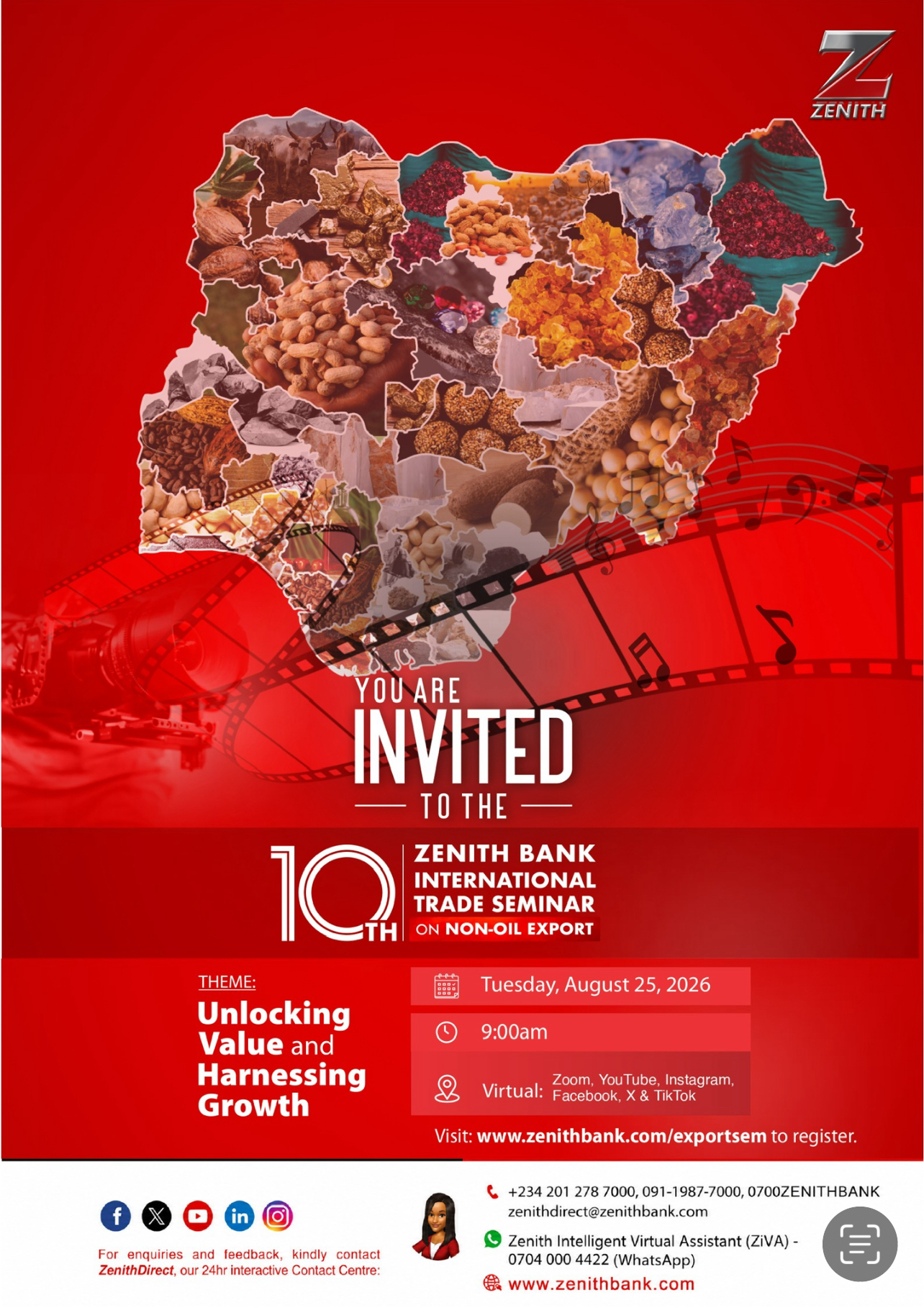
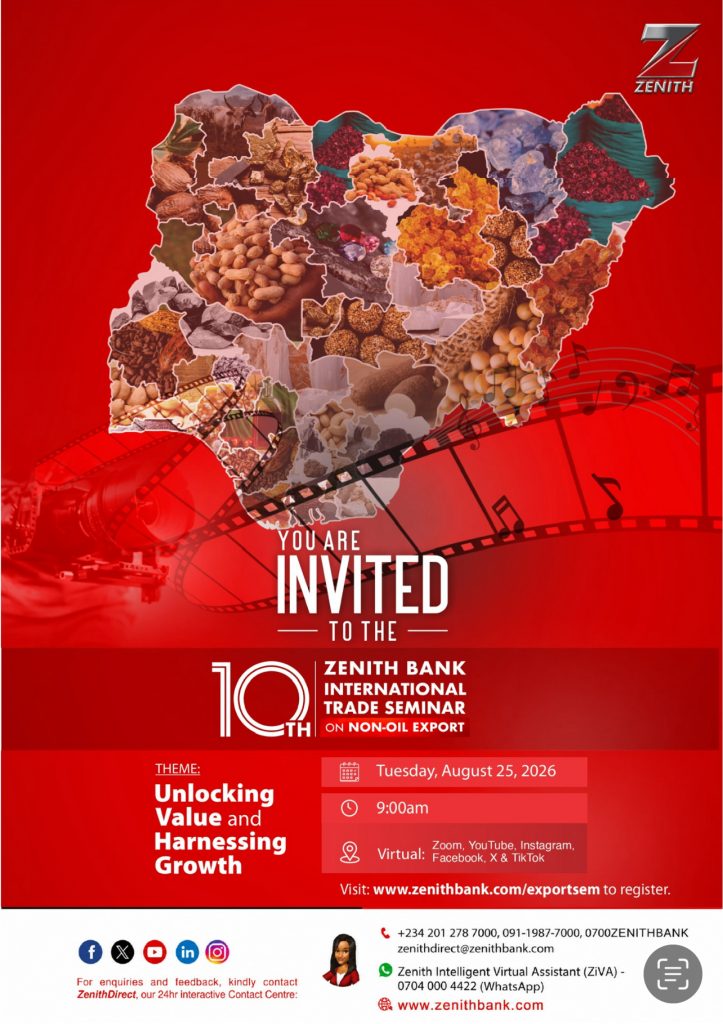
Zenith Bank Plc will host the 10th edition of its International Trade Seminar on Non-Oil Export on Tuesday, 25 August 2026, bringing together leading policymakers, regulators, exporters, manufacturers, investors and other key stakeholders to explore practical strategies for unlocking value and accelerating growth in Nigeria’s non-oil export sector.
Themed “Unlocking Value and Harnessing Growth in Non-Oil Export”, the virtual seminar will examine how Nigeria can move beyond exporting raw commodities to build globally competitive value chains, expand market access, strengthen trade infrastructure and financing, and deepen the contribution of non-oil exports to sustainable economic growth.
The high-level event will feature an impressive line-up of guest speakers, including the Secretary-General of the African Continental Free Trade Area (AfCFTA) Secretariat, H.E. Wamkele Mene; the Chief Executive Officer of Plot Enterprise Ghana Limited, Mrs Patricia Poku-Diaby; and the immediate past President and Chairman of the Board of Directors of the African Export-Import Bank (Afreximbank), Professor Benedict Oramah.
The seminar will also convene leading voices from the public and private sectors in two panel discussions. The first panel, dedicated to public sector perspectives, will bring together key stakeholders driving Nigeria’s trade, export, investment and economic development agenda. It will feature the Managing Director/Chief Executive of the Nigerian Export-Import Bank (NEXIM Bank), Mr Abba Bello; the Comptroller-General of the Nigeria Customs Service, Mr Adewale Adeniyi; the Director, Trade and Exchange Department, Central Bank of Nigeria, Ms Aderinola Shonekan; the Executive Secretary/Chief Executive Officer of the Nigerian Investment Promotion Commission (NIPC), Mrs Aisha Rimi; and the Executive Director/Chief Executive Officer of the Nigerian Export Promotion Council (NEPC), Mrs Nonye Ayeni.
The second panel, focused on private sector perspectives, will feature the Managing Director/Chief Executive Officer of Starlink Global & Ideal Limited, Alhaji Adeniji Adeyemi; the Group Executive Director, Dangote Group, Alhaji Sada Ladan-Baki; Senior Consultant at 3T Impex Trade Centre, Mr Bamidele Ayemibo; the Managing Director of Terra Aqua Environmental Consultancy Nigeria Limited, Alhaji Mobolaji Salako; the Managing Director/Chief Executive Officer of RMM Global, Mr Ramzi Taher; and the Managing Director/Chief Executive Officer of Lelook Nigeria Limited, Chief Mrs Chinwe Ezenwa.
The discussions will offer practical perspectives on trade facilitation, export financing, customs and port efficiency, regulation, market access, and the competitiveness of Nigerian businesses in regional and global markets.
A key focus of the seminar will be the African Continental Free Trade Area and its potential to open up a larger market for Nigerian goods and services while deepening intra-African trade. With the AfCFTA offering businesses access to a market of more than one billion people, the discussions will examine how Nigerian enterprises can leverage regional integration, build competitive value chains and seize emerging opportunities across the continent.
Zenith Bank has consistently championed conversations around trade and economic development. It remains at the forefront of efforts to support businesses seeking to participate more effectively in regional and international commerce. The Bank has also partnered with the AfCFTA Secretariat on initiatives to facilitate cross-border trade and expand access to opportunities across Africa.
Now in its 10th edition, the Zenith Bank International Trade Seminar has evolved into a leading platform for high-level dialogue on Nigeria’s trade and export ecosystem. Over the years, the seminar has brought together government, regulators, businesses, financial institutions, and other stakeholders to examine emerging trends, identify challenges, and proffer practical solutions to strengthen Nigeria’s position in global commerce.
The 2026 edition will build on this legacy, convening some of the most influential voices shaping Nigeria’s trade, investment and economic landscape around one critical question: how can Nigeria unlock greater value from its non-oil exports and translate its vast productive potential into sustainable economic growth?
The seminar will be held virtually and streamed live on Zoom, YouTube, Instagram, Facebook, X, and TikTok, enabling participants in Nigeria and around the world to join the conversation. Interested participants can register at www.zenithbank.com/exportsem


-
 news6 years ago
UPDATE: #ENDSARS: CCTV footage of Lekki shootings intact – Says Sanwo – Olu
-
 lifestyle6 years ago
Former Miss World: Mixed reactions trail Agbani Darego’s looks
-
 health6 years ago
Chairman Agege LG, Ganiyu Egunjobi Receives Covid-19 Vaccines
-
 lifestyle5 years ago
Obateru: Celebrating a Quintessential PR Man at 60
-
 news1 year ago
BREAKING: Tinubu swears in new NNPCL Board
-
 health6 years ago
UPDATE : Nigeria Records 790 new cases of COVID-19
-
 entertainment2 years ago
Ashny Set for Valentine Special and new Album ‘ Femme Fatale’
-
 health6 years ago
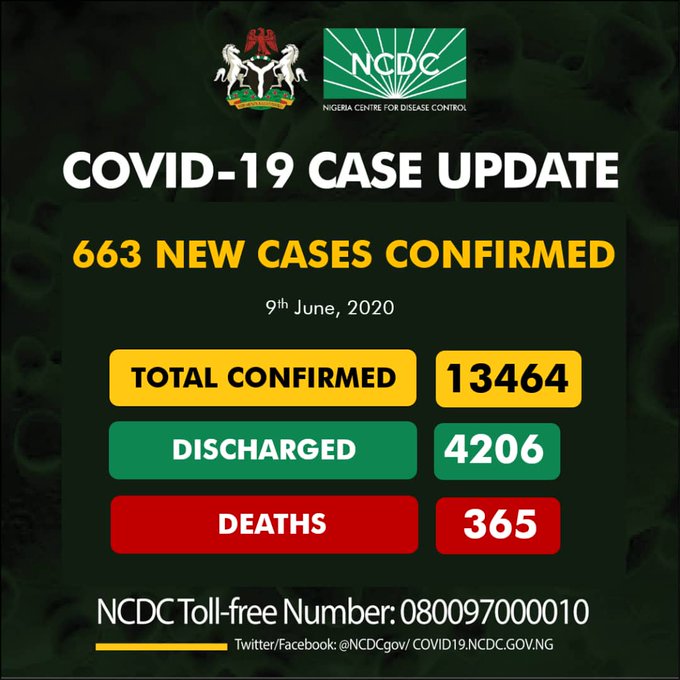
BREAKING: Nigeria confirms 663 new cases of COVID-19