…says Gbajabiamila first reported fake presidential agency to DSS, Police
…adds police file eight-count charge against suspect, two accomplices
The Presidency on Wednesday described Adeyemi Adeniyi Matthew as a con artist with a long record of elaborate scams, warning politicians and the public against using his claims to falsely implicate the Chief of Staff to the President, Femi Gbajabiamila.
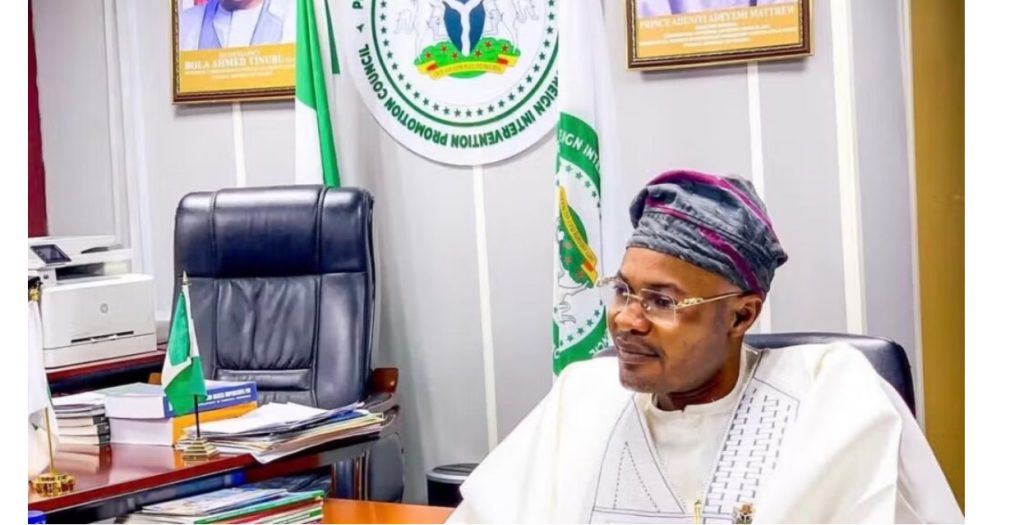
In a statement issued by the Special Adviser to the President on Information and Strategy, Bayo Onanuga, the Presidency said Matthew had been parading himself as Director-General of a fictitious Presidential Foreign Intervention Promotion Council, also referred to as the Presidential Economic Advisory Council.
Onanuga said the Office of the Chief of Staff to the President was, in fact, the first to alert security agencies to the activities of the illegal body after complaints from the Nigerian Investment Promotion Council that another so-called government agency appeared to be working at cross-purposes with it. NigeriaCurrent Affairs
According to the statement, the Chief of Staff had, in a letter dated October 17, 2025, asked the Department of State Services and the Police to investigate “fraudsters and impostors” forging appointment letters purportedly issued from his office.
The forged documents, the Presidency said, carried fake signatures, reference numbers and seals, and were being used to claim appointments into non-existent bodies, especially the so-called Presidential Foreign Intervention Promotion Council.
Gbajabiamila’s petition also alleged that Adeyemi Matthew operated from an office at the Federal Secretariat Complex, Phase III, Abuja, held meetings with Nigerians and foreigners, and requested a note verbale from the Ministry of Foreign Affairs to facilitate United States visas for some of his purported staff.
The Presidency said the Chief of Staff warned the security agencies that the development constituted a serious criminal act capable of undermining the integrity of the Presidency and official government communication.
The statement said the petition was accompanied by copies of the forged appointment letter, a request for a note verbale to the Ministry of Foreign Affairs, and pictures of engagements obtained from the illegal agency’s website.
It further added that the Ministry of Foreign Affairs had also raised concern about the fake agency after Adeyemi Matthew held a meeting with ambassadors at Wells Carlton Hotel and Apartments, Asokoro, on October 10, 2025, without recourse to the ministry.
In a letter dated October 15, 2025, signed by Ambassador Anderson Madubuike, the ministry wrote to the Office of the National Security Adviser and the Chief of Staff requesting clarification on Adeyemi Matthew’s agency, describing his action as a breach of diplomatic practice.
“This act contravenes extant rules and regulations guiding diplomatic practices globally”, the ministry stated.
The Presidency said the Office of the National Security Adviser later wrote to the Office of the Secretary to the Government of the Federation on October 20, while the OSGF, on October 29, wrote to the Chief of Staff seeking clarification following inquiries from government and non-governmental bodies.
The statement explained that Gbajabiamila had already sent a clear rebuttal to the Foreign Affairs Ministry two days earlier, stating that he never issued any appointment letter to Adeyemi Matthew as Director-General of the fake council.
He said the Chief of Staff could not have appointed anyone into a non-existent agency, adding that appointments and appointment letters are the responsibility of the Office of the Secretary to the Government of the Federation, not the Chief of Staff.
In another response to the OSGF on November 5, 2025, Gbajabiamila again denied knowledge of Adeyemi Matthew and the fake agency, saying Matthew and the so-called Presidential Foreign Investment Promotion Council were unknown to his office.
The Presidency said the Police, acting on the Chief of Staff’s October 17 petition, arrested Adeyemi Matthew on October 27, 2025, at the Abuja office where he allegedly operated the scam.
Police investigators also searched the office and Adeyemi Matthew’s residence in Suleja, recovering documents and exhibits.
In his statement to the Police, Adeyemi Matthew allegedly claimed that one Dolapo Babatunde Tanimola assisted him in procuring the fake appointment letter. Police later discovered that Tanimola had died in a fire incident at Kachi Hotel, Abuja, on October 22, five days before Matthew’s arrest.
According to Onanuga, the Police established that Adeyemi Matthew’s purported agency was fictitious, that he forged his appointment letter and other recovered documents, and that he falsely paraded himself as a government appointee.
The Police also found that he falsely solicited a note verbale from the Ministry of Foreign Affairs to secure United States visas for himself and his purported staff.
The statement further disclosed that Adeyemi Matthew operated 34 bank accounts, including nine opened in the names of fictitious agencies identified as FCT Investment Promotion Agency and Public Private Partnership, FIPA-APP, and FCT Investment Promotion Act.
It said Adeyemi Matthew allegedly used fake documents to fraudulently open a Central Bank of Nigeria account by misleading the Office of the Accountant-General of the Federation, though no government money had been transferred into the account. NigeriaCurrent Affairs
Quoting the police investigation report by Assistant Commissioner Kabir Mogaji, the Presidency said Adeyemi Matthew’s conduct amounted to criminal forgery, impersonation and obtaining by false pretence, bringing the Office of the Chief of Staff and the Presidency into disrepute before the public and the international community.
Based on the investigation, the Police filed an eight-count charge against Adeyemi Matthew and two alleged accomplices at the Federal High Court, Abuja, on November 27, 2025. He is expected in court on July 27.
The Presidency said Adeyemi Matthew was on police bail when he recently claimed that the Chief of Staff appointed him as Director-General of the fictitious agency, a claim Onanuga said contradicted his statement to the Police in November 2025.
The fresh claim, according to the statement, prompted the Chief of Staff to issue a disclaimer on June 8, 2026, consistent with earlier advisories that Adeyemi Matthew was an impostor.
“The case of Prince Adeniyi Adeyemi Matthew is a clear case of a con artist who appears to have built a web of false claims to deceive unsuspecting government officials and the public into playing by his scam book,” Onanuga said.
He added that Adeyemi Matthew had a history of fraudulent misrepresentation, recalling that in November 2016, he allegedly paraded himself as an ambassador and President-General of the World Youth Organisation, which he claimed was affiliated with the United Nations.
The statement said Adeyemi Matthew claimed to have been elected in New Delhi, India, and was celebrated by local media until the United Nations denied the existence of such a body.
The Presidency advised politicians and members of the public to disregard Adeyemi Matthew’s claims against the Chief of Staff rather than accepting his narrative without scrutiny.
It urged them to await the trial of Adeyemi Matthew and his alleged accomplices, as well as the court’s judgment, warning that public comments on the matter are sub judice.
Post Views: 21