Connect with us

news

FG enlists EFFC, ICPC on verification of ex-Airways workers severance benefits

Published

on

EFCC

….Exercise suffers hitches ; extended by one week

….Pensioners canvass special treatment for sick, elderly 

Federal Government has enlisted operatives of the Economic and Financial Crimes Commission ( EFCC) and Independent Corrupt Practices and Other Related Offences Commission ( ICPC) in the on going biometric data capture verification of ex- workers and pensioners of the liquidated national carrier : Nigeria Airways Limited.
Besides, the EFCC and ICPC, other security agencies were also enlisted for the exercise.
The participation of EFCC and ICPC personnel in the exercise, the Minister of Finance , Zainab Ahmed said was to ensure transparency, accountability for the exercise; and to ensure that people who are not qualified have acess to the money.
Speaking at the Skypower Catering Limited premises in Ikeja, Lagos on Thursday , the minister said besides displaying the relevant documents, the EFCC and ICPC officials were obtaining thumb prints of the beneficiaries.
 She was represented by the Secretary of Presidential Initiative for Continous Audit ( PICA), an arm of the Ministry of Finance, Dr Mohammed Dikwa .
Dikwa addressed the ex – Airways workers and pensioners allaying fears that hitches thus far experienced in the exercise were being looked into.
He said government was aware of the hitches and had approved extension of the verification by one week to ensure all beneficiaries are accommodated.
But, scores of pensioners and former workers have berated officials of PICA for the sloppiness of the exercise as there were not enough personnel to attend to beneficiaries that are very sick and the elderly.
They , in particular noted the paucity of personnel at the desk dedicated to the EFCC and ICPC, which they said has accelerated the delay of the exercise.
In a sift reaction, Dikwa said “We  were here to confirm that the verification is on course, and we have noted some hitches, which would be addressed with the extension of the verification for an additional week.
” The whole idea is to ensure that all beneficiaries are captured . We  call for orderliness  and pledge that we will increase the personnel  to take care of beneficiaries whose names were omitted. We understand the consequences that have come with the delay in the payment of this severance benefits, especially those that have either died, lost their documents and others. We will create a special desk for them.”
 He said government was making plans to ensure that the on going verification will be the last .
Dikwa said : ” This will be the last verification before all payments are closed. Government is paying fifty per cent now to settle the balance in the next few months. We are making plans to ensure those living outside the country are not omitted . So, there is no cause for alarm. “
 On the involvement of security agencies, Dikwa said : ” We have enlisted the services of EFCC , ICPC and other security agencies to ensure transparency and accountability of the exercise. The whole idea is to ensure that the money does not get into the wrong hands. We are going to deepen their involvement by ensuring that beneficiaries undergo bio-metric data capturing with thumb print .”
Continue Reading
Click to comment

Leave a Reply

Your email address will not be published. Required fields are marked *

news

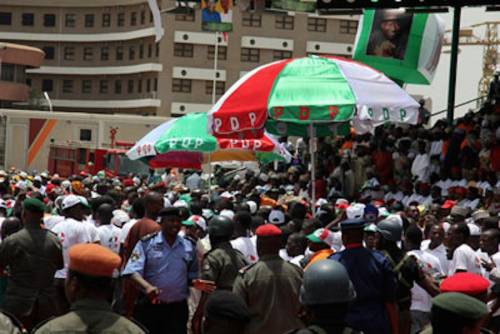
BREAKING: PDP Convention Crisis Deepens as Appeal Court Backs Order Against INEC Recognition

Published

on

…dismisses appeal, awards N2m cost against party

The Court of Appeal in Abuja has dismissed an appeal by the Peoples Democratic Party (PDP) against the October 31 judgment by Justice James Omotosho of the Federal High Court in Abuja restraining the Independent National Electoral Commission (INEC) from recognising the outcome of the national convention planned for Ibadan, Oyo State on November 15 and 16 by the PDP.

In a unanimous judgment on Monday, a three-member panel of the appellate court resolved the four issues for determination against the PDP.

It held that the appeal by the PDP was without merit and that the Federal High Court was right to have entered the October 31 judgment and granted all the reliefs sought by the plaintiffs.

The Court of Appeal faulted the PDP’s claim that the trial court lacked jurisdiction to have heard the case on the grounds that issues involved were solely internal affairs of the party.

The court also held that the plaintiffs had the locus standi to have institutes the suit to protect their democratic rights and that the PDP was not denied fair hearing as it claimed in its appeal.

The court awarded N2million cost against the PDP for filing a frivolous appeal.

The court is yet to render its decisions in the remaining eight appeals, which include judgment and rulings

Continue Reading

news

Opeifa Defends Rail Reforms, Unveils Nationwide Expansion Roadmap

Published

on

Opeifa maintained that derailments are not peculiar to Nigeria, noting that such incidents occur across advanced rail systems globally.



“Derailments are regular occurrences in the rail sector worldwide. In February alone, there were incidents in countries like Britain and others. Around the same time we experienced one, there were multiple derailments across the world,” he said.

He disclosed that in 2025, Nigeria recorded three major derailments:
• August 26 at Asham in Kaduna State
• November 1 at Abraka on the Warri–Itakpe line
• November 8 at Agbor on the same corridor

He said the NRC responded swiftly, restoring services within 24 hours in one case, while others were resolved within 21 and 28 days respectively.

Opeifa stressed that derailments can result from factors such as weather conditions, signal glitches, human error, speeding, or aging infrastructure, but noted that in Nigeria’s recent cases, there were no fatalities.

“These incidents are preventable and efforts are ongoing to minimize them. However, they should not be seen as major setbacks to the overall progress of the railway system,” he said.

On Allegations of Mismanagement

Addressing allegations of financial mismanagement within the corporation, Opeifa declined detailed comments, citing ongoing legal processes.

“When a matter is in court, it is sub judice. Allegations of corruption or mismanagement should be handled by the appropriate authorities,” he stated.

He reiterated that his priority is to reposition the NRC in line with global best practices and ensure efficient rail services for Nigerians.

Expansion, Upgrades and National Connectivity

The NRC boss said efforts are underway to restore damaged coaches and upgrade infrastructure using local engineers and technicians.

“We are bringing back the lines and retrofitting coaches. The Warri–Itakpe line is operational. The Abuja–Kaduna line is running, and we are increasing trips from two to three,” he said.

On long-term plans, Opeifa disclosed that the NRC roadmap envisions rail connectivity across major cities nationwide, subject to funding and phased execution.

He dismissed claims of abandoned projects, explaining that rail developments are capital-intensive and implemented in phases based on available resources.

He cited progress on the Lagos–Ibadan corridor—part of the larger Lagos–Kano project—as well as ongoing work on the Kano–Maradi line linking key northern cities.

Lagos–South-East, Port Connections in View

Opeifa also highlighted plans to expand connectivity between southern ports and inland cities. These include proposed links from Warri to Abuja and from Lekki Deep Sea Port to Kajola, Benin, Onitsha, and Aba, enabling both passenger and cargo movement.

Toward Modern Signaling and Faster Trains

On modernization, he said Nigeria is gradually upgrading from older narrow-gauge systems to standard-gauge infrastructure with improved signaling technology.

He noted that metro rail projects in Kaduna, Kano, and Lagos are being developed with higher signaling standards, positioning the country for faster and more efficient train services in the coming years.

“We are not yet at the highest global level, but we are moving steadily upward,” Opeifa said.

Continue Reading

news

Ticket Reform Boosts Confidence in Lagos–Ibadan Rail Service, Says Opeifa

Published

on

A quiet transformation is reshaping the daily commute between Nigeria’s commercial hub and the historic city of Ibadan. Passengers on the Lagos–Ibadan standard gauge corridor say services have become more efficient and predictable following a clampdown on ticket racketeering led by Kayode Opeifa

The renewed confidence in the rail line linking Lagos and  is influencing residential and employment decisions among middle-income earners who once considered daily intercity commuting unrealistic.

“It is now possible to live in Ibadan and work in Lagos without the daily anxiety of securing a ticket,” said Adewale Bamidele, a financial analyst who travels three times a week. “Before, you needed connections. Now, you book, you board, you arrive.”

A Line Once Hindered by Middlemen

The Lagos–Ibadan railway, inaugurated as a flagship infrastructure project under the administration of former President Buhari was designed to ease pressure on the congested Lagos–Ibadan Expressway and deepen economic integration across the South-West.

However, in its early phases, passengers frequently complained of informal ticket rackets. Allegations included bulk-buying by intermediaries and artificial scarcity that forced travellers to pay inflated prices for seats on high-demand trains.

Industry observers say such practices undermined the railway’s credibility as a mass transit solution. “Transport systems thrive on predictability and fairness,” said a transport economist “Once access is perceived as compromised, commuters revert to road transport despite the risks and delays.”

Enforcement and Digitisation

Since assuming oversight responsibilities within the sector, Opeifa has reportedly intensified internal monitoring and strengthened digital ticketing protocols. Railway officials, speaking on condition of anonymity, said stricter verification processes and disciplinary measures against errant staff have curtailed unauthorised ticket sales.

Although the Nigerian Railway Corporation has not released detailed enforcement data, anecdotal evidence from regular commuters points to shorter queues, smoother boarding procedures and fewer last-minute cancellations.

For professionals with flexible work schedules, the improvement has been significant. The average journey time of about two to three hours—depending on the service type—now compares favourably with unpredictable road travel, which can take considerably longer during peak traffic.

Changing Urban Dynamics

Property agents in Ibadan report a modest rise in enquiries from Lagos-based workers seeking more affordable housing. Rents in many parts of Ibadan remain significantly lower than comparable neighbourhoods in Lagos, offering relief to households grappling with inflationary pressures.

“Rail reliability changes everything,” said Funke Adebayo, a real estate consultant in Ibadan. “When people trust the timetable, they are more willing to relocate.”

Economists caution, however, that long-term success will depend on consistent maintenance, adequate security along the corridor and transparent ticketing systems. Any return to informal practices could quickly erode recent gains.

The Lagos–Ibadan corridor is widely regarded as a litmus test for Nigeria’s broader rail ambitions. With additional standard gauge projects planned or underway nationwide, policymakers face mounting pressure to ensure that infrastructure investments translate into reliable public service delivery.

For now, passengers remain cautiously optimistic.

“It feels more organised,” Bamidele said while disembarking at Mobolaji Johnson Station in Lagos. “If this standard is sustained, rail can genuinely compete with road transport.”

Nigeria agree, the real challenge lies not just in laying tracks, but in sustaining public trust.

Continue Reading

Trending

Copyright © 2025 Newsthumb Magazine | All rights reserved